"You Gotta Die From Something": What My Father's Heart Failure Taught Me About Prevention

- Heart failure is rarely sudden. It is usually the end of decades of unchecked blood pressure, smoking, drinking, poor sleep, chronic stress, and missed prevention.
- "You gotta die from something" is true — but how long you suffer, and how many good years you get first, is often still up to you.
- Warning signs like breathlessness on stairs, swollen ankles, waking up short of breath, and fatigue deserve a same-week visit, not a wait-and-see.
- Prevention works best when it's built around the person — their job, their stress, their food, their history — not a generic pamphlet.
On a regular Monday in September 2014, my phone rang. It was my brother. I was in Atlanta; he was in Chicago. And he was frantic.
Our father — a Vietnam veteran, a Chicago police officer for over three decades, the strongest man either of us knew — was struggling to breathe. A technician was at the house fitting him for a new home oxygen device, and his oxygen level was reading 88%.
I'm a physician. I knew exactly what that number meant. The technicians were trying to get him to the hospital, and I joined in, begging him over the phone to go.
He wouldn't. "I'm tired," he said. "I'm so disgusted with myself."
The next day, he died of heart failure.
I tell this story often, and it doesn't get easier. But I tell it because I've since sat across from hundreds of patients who remind me of him — capable, proud, busy people who have quietly accepted that their health is just going to decline. I want this post to do for you what I couldn't do for my dad in time.
"You Gotta Die From Something"
That was his favorite saying. He smoked. He drank. He ate the Standard American Diet that most of us grew up on. And whenever anyone raised it, he'd shrug: *you gotta die from something.*
He wasn't wrong, technically. We all die from something — a heart attack, a stroke, an accident, or peacefully in our sleep at ninety-five.
But here's what that phrase hides: there is a very big difference between dying from something and suffering from something for fifteen years first. My father didn't just die of heart failure. He lived with a slowly failing heart for years — the breathlessness, the exhaustion, the oxygen tank, the regret. That part didn't have to happen.
Heart Failure Is a Slow Story, Not a Sudden Event
When people hear "heart failure," they often picture a heart that suddenly stops. That's cardiac arrest. Heart failure is different: the heart muscle becomes too weak or too stiff to pump blood efficiently, and fluid backs up into the lungs, legs, and belly.
It almost never arrives out of nowhere. In my father's case — like most cases I see — it was the end of a very long road:
| Stage | What's Happening | What It Feels Like |
|---|---|---|
| Risk factors (years 0–20+) | High blood pressure, smoking, excess alcohol, insulin resistance, poor sleep, chronic stress | Usually nothing. You feel "fine." |
| Structural change | The heart wall thickens or stiffens from years of pushing against high pressure | Maybe slightly less stamina; easy to blame on age |
| Early symptoms | The heart can no longer keep up during exertion | Winded on stairs, ankles swell by evening, more tired than usual |
| Advanced heart failure | The heart can't keep up even at rest | Short of breath lying down, waking up gasping, needing oxygen |
The good news hidden in that table is the first row. The years when you feel fine are the years when prevention is most powerful — and they are also the years most of us ignore.
The window that matters most is the one where you feel fine. By the time heart failure causes symptoms, the heart has usually been under strain for a decade or more.
It Wasn't Just Cigarettes
After he died, I kept turning his life over in my head. The cigarettes and the drinking were obvious. But they weren't the whole story.
My father was a Black man in America. A veteran who came home from war. A police officer in one of the most stressful jobs in one of the most stressful cities in the country. The provider for his family. He carried all of that for decades, mostly in silence, and nobody — including me — ever asked how that load was landing on his heart.
We now know that chronic stress isn't just a feeling. It keeps the body flooded with stress hormones, raises blood pressure and heart rate, drives inflammation, and pushes blood sugar and weight in the wrong direction (1). Researchers have even given a name to how the constant pressure of racism and hardship ages the body faster: *weathering* (2).
So when I look back, I don't see one bad habit. I see a stack:
- Biology: high blood pressure that likely went undertreated for years
- Behavior: smoking, alcohol, and a diet built on convenience
- Burden: decades of job stress, trauma, and racial stress with no outlet
- Barriers: a medical system that saw him for fifteen-minute visits and focused on prescriptions, not prevention
Most of the heart disease I treat today has the same shape. It's never just one thing.
Warning Signs Families Miss
If someone you love is over 40 — especially with high blood pressure, diabetes, a smoking history, or a family history of heart disease — please don't wait for an oxygen reading of 88%. These are the signs I want families to take seriously:
| Sign | Why It Matters | What To Do |
|---|---|---|
| Winded on stairs or short walks that used to be easy | The heart may not be keeping up with demand | Book a visit this week |
| Ankles or legs swollen by evening | Fluid may be backing up | Book a visit this week |
| Needing extra pillows to breathe at night | Fluid in the lungs worsens lying flat | Call your doctor today |
| Waking up gasping for air | A classic sign of worsening heart failure | Call your doctor today |
| Rapid weight gain over a few days | Usually fluid, not fat | Call your doctor today |
| Chest pain, fainting, or severe breathlessness at rest | Possible emergency | Call 911 |
And here's the hard part I learned: knowing the signs isn't enough if the person you love doesn't want to hear it. My father knew he was sick. What he didn't have was hope that change was possible — or a doctor who made change feel doable.
What I'd Do Differently Now
I'm his daughter, not his doctor — even though I am a doctor. But I didn't know about functional medicine back then. Here's what I wish someone had offered him, and what I now offer my own patients.
1. Find the real numbers, early
Blood pressure measured at home, not just once a year in an office. A full lipid picture, including the markers that standard panels skip. Fasting insulin and A1c to catch insulin resistance early — I explain why in my post on the fasting insulin test your annual physical skips. Inflammation markers. Kidney function. These give us a map years before symptoms do.
2. Make change feel like a life, not a punishment
My father didn't need a lecture. He'd heard plenty. He needed changes he could actually enjoy — food he liked, movement that fit his life, a reason to want more years. In my practice, we start with one or two changes a patient chooses, not a list of fifteen rules.
3. Treat stress like a risk factor — because it is
We screen for blood pressure and cholesterol. Very few people are ever asked about chronic stress, trauma, sleep, or what their work is doing to them. I ask. Then we build a plan: sleep repair, breathing practices, movement, counseling when needed, and honest talk about boundaries.
4. Bring the family in
Heart disease runs in families partly through genes and partly through habits, kitchens, and stress patterns. When I lost my dad, I looked hard at my own risk too. If someone in your family has heart failure or had an early heart attack, your own prevention plan should start now.
5. Partner, don't prescribe and disappear
Medication matters, and I prescribe it when it's needed. But a pill without a partnership rarely changes the story. Real prevention means follow-up, retesting, and adjusting — the opposite of a rushed annual visit.
He Didn't Have to Suffer
I've made peace with the fact that I couldn't save my father. But his story is not unusual. It's shared by countless families — Black families especially — who've watched someone they love decline from a disease that gave plenty of warning.
That's why I do this work. And it's why I gave a talk about it, which you can watch here. This post is the first of three drawn from that talk. Next week, I'll look at how your zip code and race-based medicine shape heart risk; the week after, at what functional medicine actually does differently.
The Bottom Line
You gotta die from something. But you don't have to spend your last fifteen years struggling to breathe. Heart failure is usually the final chapter of a long story — and most of that story can still be rewritten if you start while you feel fine.
Products and Protocols: Test, Don't Guess
Supplements never replace blood pressure control, quitting smoking, or a real prevention plan. These are the ones I most often discuss with patients *after* testing shows a reason to use them.
| Finding | Supplement Strategy to Discuss | My Product Pick | Recheck / Key Caution |
|---|---|---|---|
| Low omega-3 index or high triglycerides | Omega-3s with verified EPA/DHA content | Omega Ultra TG | Check bleeding risk with blood thinners; retest triglycerides in 8–12 weeks |
| Low magnesium, poor sleep, or high stress | Glycinate or taurate forms to support sleep, muscle, and heart rhythm | Multi Mag | Avoid unsupervised use with kidney disease; separate from thyroid medication |
| Low fiber intake, high LDL | Soluble fiber to support cholesterol and blood sugar | Perfect Fiber 200 Grams | Start slowly with plenty of water; separate from medications by 2+ hours |
My rule: if it can't be tied to a measured number, it doesn't go in your cabinet. Browse the MaxHealth Nutraceuticals collection or read my evidence-based supplement guide first.
*Affiliate disclosure: Some product links may earn us a commission at no additional cost to you. Recommendations are based on clinical use, not commissions. Read the full disclosure.*
If you have heart failure, kidney disease, or take blood thinners, diuretics, or heart rhythm medication, do not start any supplement without your clinician's review.
References
- Kivimäki M, Steptoe A. Effects of stress on the development and progression of cardiovascular disease. Nature Reviews Cardiology. 2018;15(4):215-229. https://doi.org/10.1038/nrcardio.2017.189
- Geronimus AT, Hicken M, Keene D, Bound J. "Weathering" and age patterns of allostatic load scores among Blacks and Whites in the United States. American Journal of Public Health. 2006;96(5):826-833. https://doi.org/10.2105/AJPH.2004.060749
- Heidenreich PA, Bozkurt B, Aguilar D, et al. 2022 AHA/ACC/HFSA Guideline for the Management of Heart Failure. Circulation. 2022;145(18):e895-e1032. https://doi.org/10.1161/CIR.0000000000001063
- Bibbins-Domingo K, Pletcher MJ, Lin F, et al. Racial differences in incident heart failure among young adults. New England Journal of Medicine. 2009;360(12):1179-1190. https://doi.org/10.1056/NEJMoa0807265
Supplements for Heart Health
Clinical-grade picks for this topic
Affiliate disclosure: The product links below are affiliate links — we may earn a commission at no extra cost to you. Recommendations are based on clinical use, not commissions. Learn more.
Frequently Asked Questions
Common questions about "you gotta die from something": what my father's heart failure taught me about prevention
Recommended Supplements
Professional-grade supplements from my MaxHealth Nutraceuticals line — the same formulas I use in clinical practice.
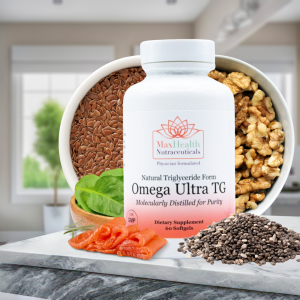
Omega Ultra TG

Multi Mag

Perfect Fiber 200 Grams
Disclosure: This post contains affiliate links. If you purchase through these links, we may earn a small commission at no extra cost to you. Learn more.
About the Author
Dr. Nicolle is a double board-certified physician in Family Medicine and Preventive Medicine, with certifications in Functional Medicine and Lifestyle Medicine. She helps busy professionals over 40 optimize their health through root-cause approaches to cardiovascular, hormonal, and metabolic health.
Learn more about Dr. Nicolle →Explore Related Topics
Dive deeper into these connected health areas
Hormone Health
Hormones are the chemical messengers that regulate virtually every process in your body — from metab…
Explore 🦠Gut Health
Your gut is far more than a digestive organ — it's home to 70% of your immune system, produces key n…
Explore ❤️Metabolic Health
Metabolic health sits at the intersection of blood sugar regulation, cardiovascular function, body c…
Explore 🌸Women's Health
Women's health encompasses a complex interplay of hormonal cycles, reproductive biology, and unique …
Explore 💪Men's Health
Men's health involves a unique interplay of hormonal balance, cardiovascular resilience, metabolic e…
Explore 🧠Mental Health
Mental health is deeply interconnected with hormonal balance, gut health, blood sugar regulation, an…
Explore 📖Skin & Hair Health
Your skin and hair are windows into your internal health. Chronic acne, eczema, psoriasis, and hair …
ExploreReady to Address Your Health Concerns?
Book a Discovery Offer consultation to discuss how our functional medicine approach can help you achieve your health goals.
Join the Waitlist